
Eisenhower: a general to better manage your priorities
Dwight D. Eisenhower, Supreme Commander of the Allied forces in Europe and then President of the United States from 1953 to 1961, gave his name to a simple way of sorting tasks: cross their urgency with their importance. An important and urgent action is done right away, an important but not urgent one is scheduled, an urgent but unimportant one is delegated, and one that is neither is dropped. This sorting helps you escape the "everything is a priority" trap, which in the end leaves nothing as a priority.
When everything is a priority, nothing is
It is not always easy to find a simple order for ranking your tasks or actions. Which one comes before the other? And if everything is a priority, then in the end nothing really is. Yet since nobody can carry out several tasks at the same moment, we make this kind of trade-off every day, often without thinking about it.
Most of the time, urgency decides: the message that has just arrived, the most pressing request, the most insistent reminder. But are our criteria relevant? How do you prioritize your actions properly when everything seems to be a priority?
A general facing priorities
One man gave his name to the best-known answer: Dwight David Eisenhower. As Supreme Commander of the Allied forces in Europe, he led the Normandy landings of June 6, 1944, before being elected President of the United States for two terms, from 1953 to 1961. Given the responsibilities he carried, it is with some humility that we look at the way he sorted problems.
In a 1954 speech, he explained that he had two kinds of problems, the urgent and the important, and that the urgent are rarely important while the important are rarely urgent. He presented this idea as that of a former college president. The four-box matrix came later and was popularized by Stephen Covey. Our article on the history of the Eisenhower matrix traces this path.
What today's managers retain is the distinction itself: urgency tells you when something calls for a response, importance tells you whether it contributes to your objectives. The two do not necessarily go together, and it is by separating them that you take back control of your schedule.
The Eisenhower matrix: a simple and effective tool
The priority of an action is read by crossing two factors: urgency and importance. This system is represented as a two-way table, with the degree of urgency on one axis and the degree of importance on the other.
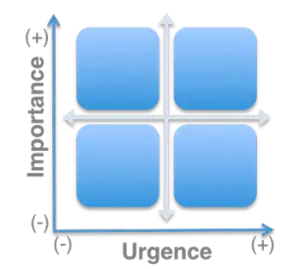
Every action falls into one of four categories, each with its own treatment:
| Category | Treatment | Example |
|---|---|---|
| Important and urgent | Do it immediately | Answer a customer complaint that is blocking a delivery |
| Important, not urgent | Schedule it in your calendar | Prepare next year's budget |
| Urgent, not important | Delegate it if possible | Book a room for tomorrow's meeting |
| Neither important nor urgent | Drop it, or keep it for a free moment | Sort out old shared folders |
The step-by-step method, with a filled-in example, is in our guide how to use the Eisenhower matrix. You can also download an Eisenhower matrix in Excel, PDF or PowerPoint format.
Applying Eisenhower's logic as a team
The matrix is often presented as a personal organization tool. It is just as useful for a team, provided you adapt a few rules:
- Define importance against shared objectives. A task is important if it moves a team objective forward, not because it was requested by the most senior person.
- Delegating means handing over with a due date. An urgent but unimportant action that goes to a colleague needs an owner and a date, otherwise it comes back.
- Protect the "important, not urgent" quadrant. It holds the long-term projects, prevention and improvement work. Block time for it, or it will always be pushed back.
- Review priorities in meetings. A quick check-in each week is enough to move actions from one box to another when the context changes.
Other approaches complement this sorting. Our article on the importance of prioritization in task management shows how to apply it to a team's day-to-day work.
How Perfony interprets the matrix
We looked into this question of priorities in response to requests from our users. Tools on the market often use exclamation marks, colored flags or numerical scores, where you never know whether "1" is the lowest or the highest priority.
We wanted Perfony not only to let you set a priority, but also to help you assess it. The priority level of an action is shown as a small four-box matrix that fills up as the priority rises, from priority 1 to priority 5.
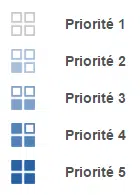
Because Perfony aims to be simple and flexible, you can also keep a traditional score-based prioritization with the same set of icons. This interpretation of the matrix is not binding: it helps make the order of actions more objective without upsetting the habits already in place in the company.
Pitfalls to avoid
- Classifying everything as "urgent and important". If this box overflows, it is often a sign that importance has not been assessed honestly, or that the "schedule" quadrant has been neglected for too long.
- Confusing urgent with loud. An insistent request is not necessarily urgent: ask yourself what really happens if it waits a day.
- Delegating without follow-up. A task handed over with no due date and no checkpoint is a forgotten task.
- Doing the matrix once and for all. Priorities move: the matrix should be reviewed every week, or even every day.
For more practical advice, see our 9 easy-to-implement tips to manage your priorities better.
In practicePrioritize and track your actions with PerfonyEach action has a priority, an owner and a due date. Delegated actions stay visible and reminders go out automatically. Free 15-day trial.Discover the action plan softwareFrequently asked questions
Who was Dwight D. Eisenhower?
An American general, Supreme Commander of the Allied forces in Europe during the Second World War, then President of the United States from 1953 to 1961.
What is the difference between urgent and important?
Urgency tells you how soon a task needs a response; importance tells you whether it contributes to your objectives. A task can be one without the other.
What should you do with urgent but unimportant tasks?
Delegate them where possible, with an owner and a due date, to keep your own time for important tasks.
Did Eisenhower invent the four-box matrix?
No. He stated the distinction between urgent and important in a 1954 speech; the four-quadrant matrix was popularized later by Stephen Covey.