
History of the Eisenhower Matrix
The Eisenhower matrix is named after Dwight D. Eisenhower, Supreme Commander of the Allied forces in Europe during World War II and 34th President of the United States. In a 1954 speech, he quoted the idea that what is urgent is seldom important, and what is important is seldom urgent. The four-quadrant table that bears his name was formalized much later, and popularized in 1989 by Stephen Covey.
Who was Dwight D. Eisenhower?
Dwight David Eisenhower (1890 to 1969) was an American career officer. During World War II, he headed SHAEF (Supreme Headquarters Allied Expeditionary Force), the supreme command of the Allied forces in Western Europe. In that role, he led the planning and execution of the Normandy landings of June 6, 1944, one of the most complex military operations ever organized.
He was promoted to General of the Army in December 1944, the highest rank in the US Army in wartime. In June 1945, General de Gaulle made him a Companion of the Liberation. In 1950, he became the first Supreme Allied Commander of NATO forces in Europe.
Elected President of the United States in 1952, he served two terms, from 1953 to 1961. His presidency saw, among other things, the end of the Korean War in 1953, the launch of the Interstate Highway System in 1956 and the creation of NASA in 1958.
These responsibilities explain why his name is linked to priority management: for decades, Eisenhower had to choose every day between pressing matters and decisive ones, with enormous consequences either way.
The 1954 quote
In August 1954, Eisenhower addressed the Second Assembly of the World Council of Churches, held at Northwestern University in Evanston, near Chicago. He explained that he had two kinds of problems, the urgent and the important, and that "the urgent are not important, and the important are never urgent."
He did not claim the idea as his own: he presented it as a thought he owed to a former college president. That person is often identified as J. Roscoe Miller, then president of Northwestern University, although the speech itself does not name him. It is this passage, usually rephrased as "what is important is seldom urgent and what is urgent is seldom important", that gave the method its name.
From a quote to a matrix: Stephen Covey's role
The four-quadrant version we know today was popularized by Stephen Covey in The 7 Habits of Highly Effective People, published in 1989. Covey presents a time management matrix that crosses urgency and importance, and he insists on the quadrant of tasks that are important but not urgent: that is where, in his view, long-term effectiveness is built.
The book's success turned the matrix into a classic of management and personal organization training. Eisenhower's name stuck to it, which is why people speak interchangeably of the Eisenhower matrix, the urgent-important matrix, the Eisenhower box or the Covey matrix.
The principle in a nutshell
The matrix relies on two questions asked about every task. Is it important, meaning does it contribute to my objectives? Is it urgent, meaning will waiting have an immediate consequence? Crossing the answers gives four quadrants, each linked to a decision.
| Urgent | Not urgent | |
|---|---|---|
| Important | Do it now | Schedule a date |
| Not important | Delegate it | Delete it |
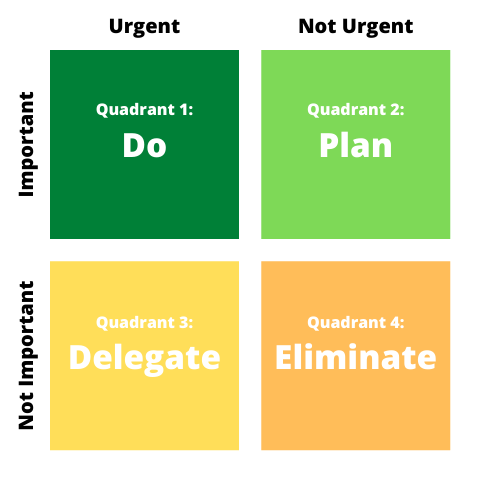
The hard part is not understanding the table, but honestly telling the urgent from the important. Urgency announces itself; importance has to be judged. The step-by-step method, with a concrete example, is covered in our guide on how to use the Eisenhower matrix.
Why the matrix is still useful today
Eisenhower's observation is more relevant than ever. Emails, instant messages, notifications and meetings create a continuous flow of requests that all look urgent. Without a simple rule to sort them, days fill up with answers to whatever is pressing, at the expense of what really matters.
The matrix provides that rule. It helps you:
- protect time for important topics before they turn into emergencies;
- spot what can be handed over to someone else;
- accept not doing some tasks at all;
- explain your choices to your team or your manager.
It is not the only prioritization method: MoSCoW, the ABCDE method or the Pareto principle answer other situations. Our overview of 7 ways to manage your priorities at work helps you choose, and our article on the importance of prioritization in task management explains why it matters. To get started right away, you can also use an Eisenhower matrix template to download.
In a team, the logic is the same with one difference: the tasks you schedule or delegate become shared actions, which need an owner, a due date and follow-up. More practical advice for managers is gathered in our resources for effective managers.
In practiceManage tasks and priorities with PerfonyTurn your priorities into tracked actions: an owner, a due date, a progress status, and reminders that go out on their own. Integrated with Microsoft Teams, hosted in France.Discover action managementFrequently asked questions
Who invented the Eisenhower matrix?
The principle comes from a 1954 speech by Dwight D. Eisenhower that distinguished the urgent from the important. The four-quadrant table was popularized in 1989 by Stephen Covey in The 7 Habits of Highly Effective People.
Is the quote about urgent and important really from Eisenhower?
Eisenhower said it in 1954, but he attributed it to a former college president, often identified as J. Roscoe Miller of Northwestern University.
What is the difference between the Eisenhower matrix and the Covey matrix?
They are the same tool. Eisenhower's name refers to the origin of the principle, Covey's to the four-quadrant version he made popular.
Is the Eisenhower matrix still useful today?
Yes. Faced with a constant flow of emails, messages and meetings, it gives a simple rule to separate what is pressing from what matters, and to protect time for important work.