
How can we help?
Create and manage custom fields for actions
1/ Defining a customised field of action
A custom field is a zone in which you can attach data to an action.
You can have as many custom fields as you like for an action.
The advantage is that you can sort action plans according to the values in these custom fields.
For example, as part of a quality, safety or certification action plan, we can link actions to types of anomaly or process.
In addition to the filters and sorting options, it will also be possible to create visual graphs by custom field value (see graphical dashboard).
These fields can be customised via the “Groups” menu by clicking on “Add a custom field” .
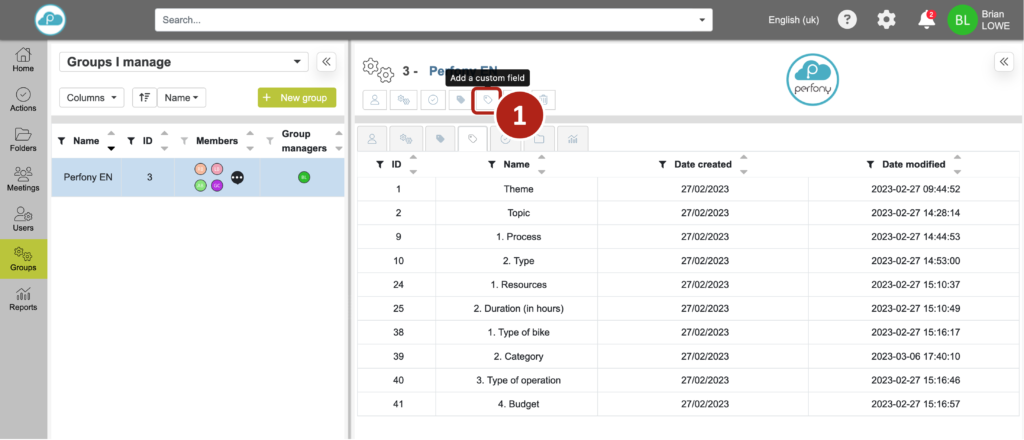
2/ Customise action fields
When you click on “Add a custom field”, a popup window appears invites you to :
Give a name to your field and select the type of field. There are 3 possibilities:
-
- A free field for text
- A fixed list for a drop-down menu
- A field for numerical values
In the following example, we select “fixed list”. When clicked, a field appears below in which you can enter the desired values.
These values will appear in the list of possible choices for your file. The order of the values in the list is as shown here.
You can also define a default value for the custom field. Whenan action is created, the default value will be automatically filled in. Enter the first few letters of the default value and select the one you want.
The default value must be one of the values listed above.
Then there are four boxes to tick if you wish:
-
- Hide the values of the search function field (if your fields are numerical values, there’s really no point in displaying them)
- Make entry of the field mandatory when creating or closing the action (useful for having a complete action database)
- Pre-fill sub-actions with values already entered in the main action (to save time)
Once you have completed your list and choices, click “Add” and your custom field will appear in the list of action fields.

3/ Modifying a customised action field
You can change a custom field at any time. To do this, click on the “Custom fields for actions” tab and select the required field .
The configuration popup appears and you’ll be able to :
-
- change field name
- add/modify/remove values from the list
- tick or untick the boxes to hide the search, obligation and pre-fill sub-actions
- delete the field
- change the default fill value
Please note: any deletion or modification of a value in a list will result in the disappearance of the value in the current actions (status from 0% to 100%). Closed actions, on the other hand, will retain their previous values.
You cannot change the nature of the field. If your field has been created on a “fixed list” model, you cannot transform it into a free-form or numeric format. You then need to create a new field.
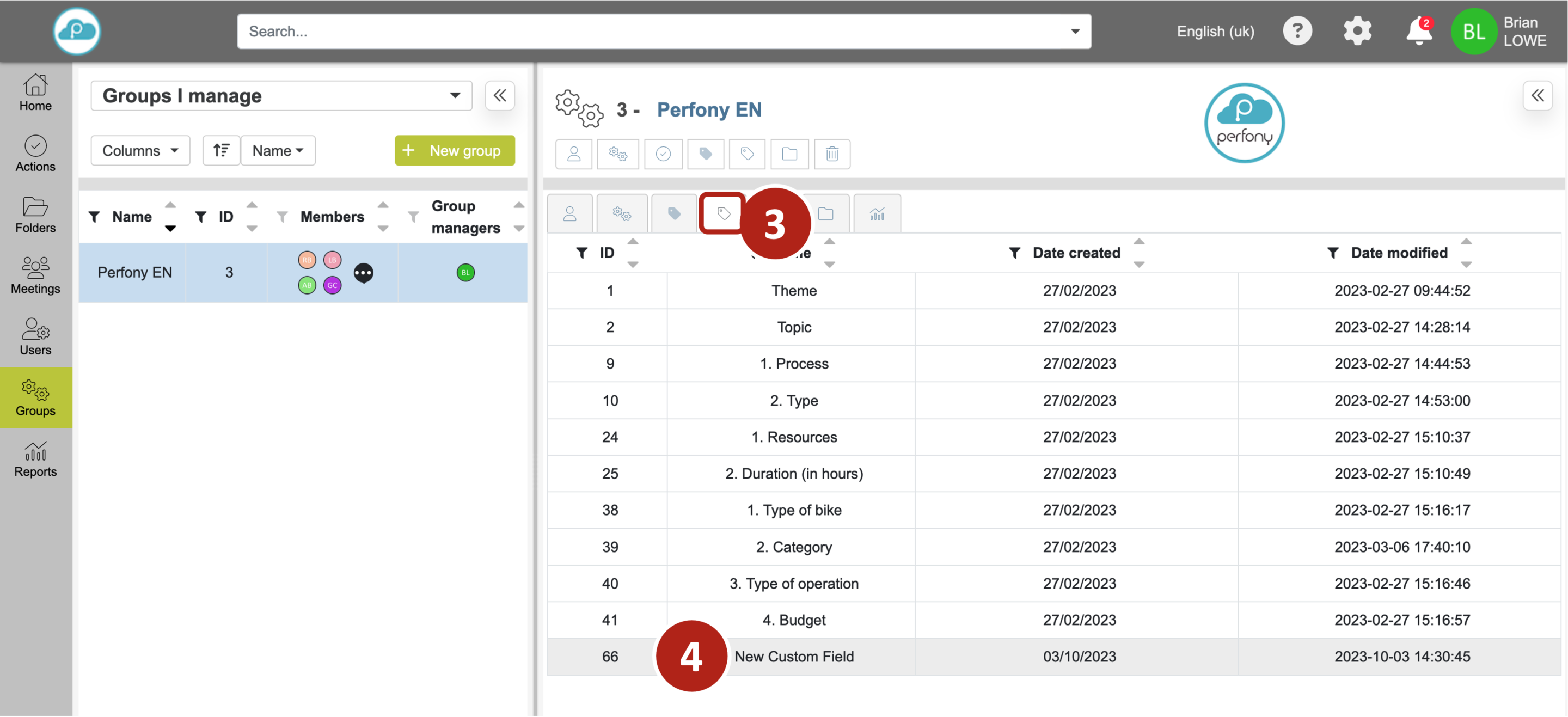
4/ Use a custom field for your actions
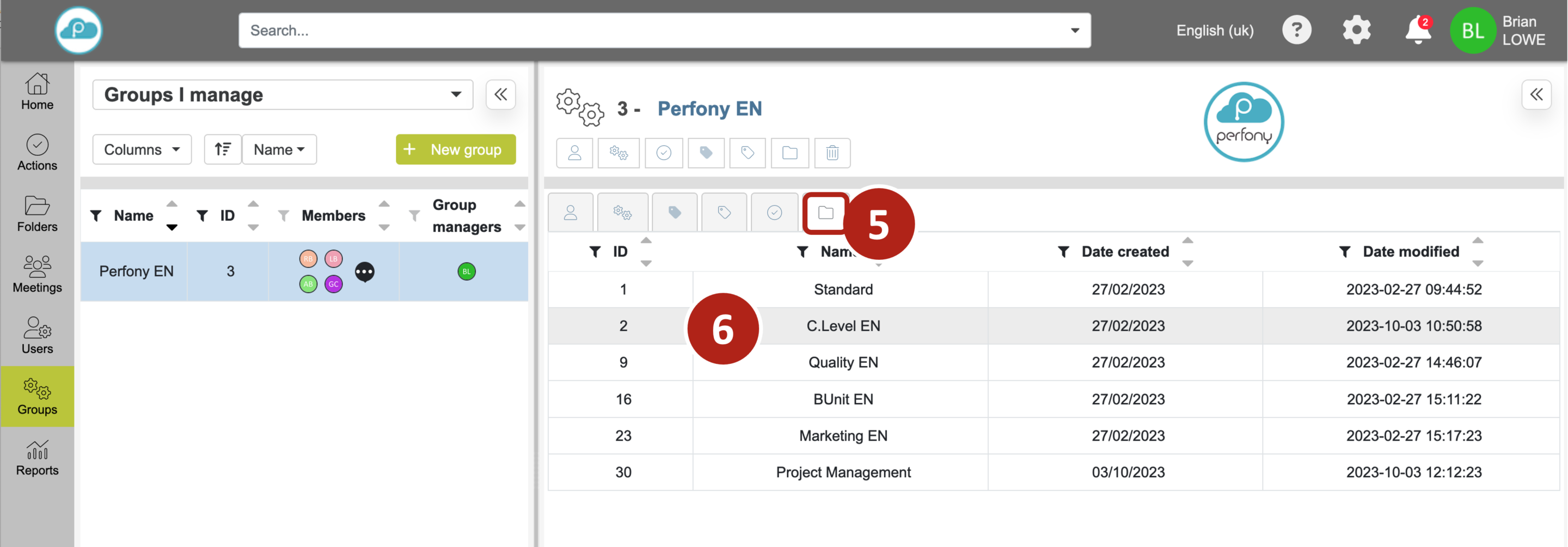
Here’s how to attach a custom actions field to a folder template. Click on the “folder template” tab , select model (to create a folder template, see the “Create and manage folder templates” page).
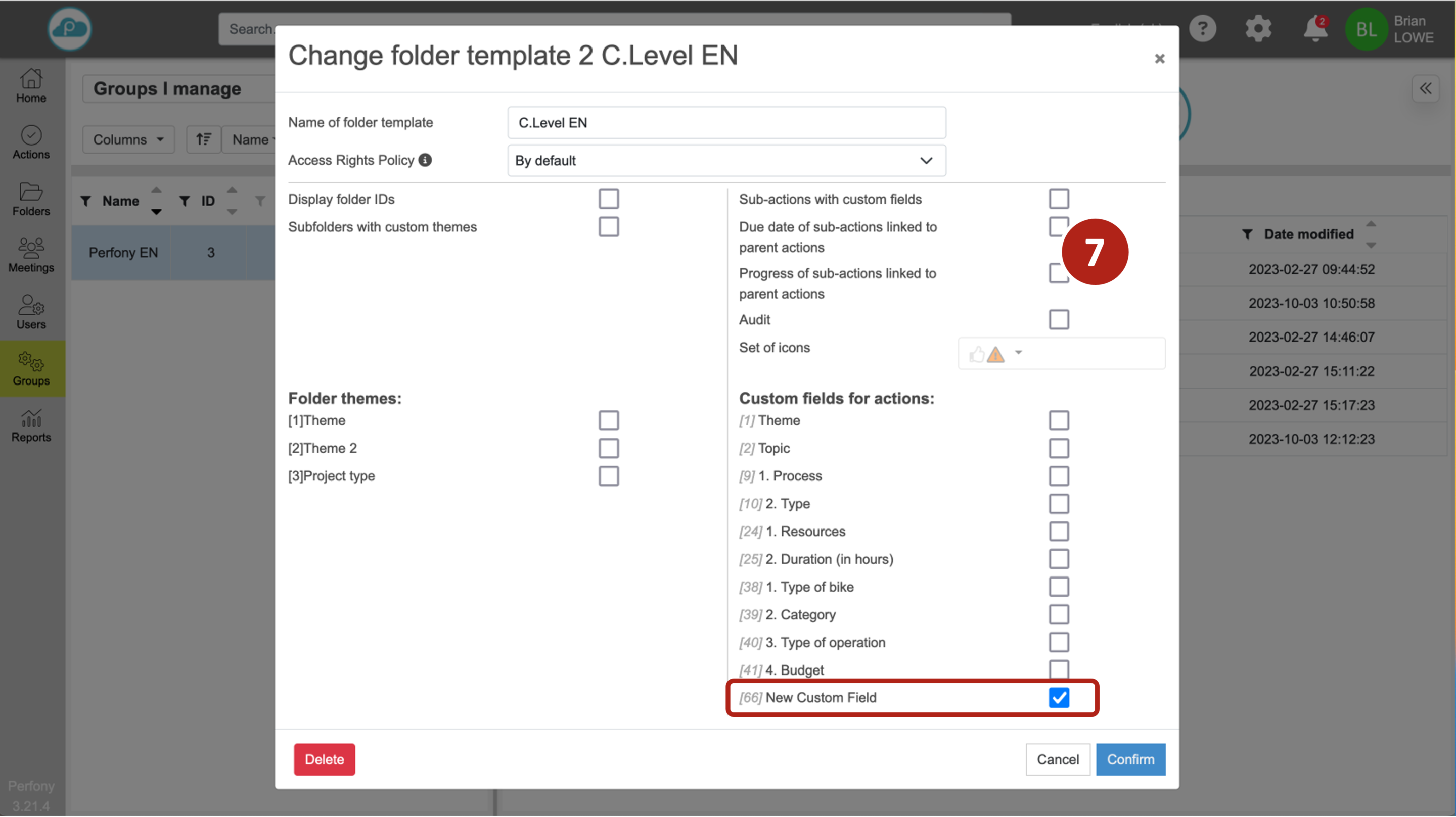
The folder template configuration window appears. On the right-hand side is the list of custom fields available in your group. Select one (or as many custom fields as you like), confirm your choice and the window will close.
You will now have this custom field for your actions which have this folder template.
5/ Multiple-choice options for folder themes and custom action fields
A folder theme or custom action field can be configured to accept only one value at a time, or to accept multiple values at the same time.
Set Up a Multiple-Choice Field
In the Groups menu, when creating or editing a custom field (or a folder theme), the “Field Type” drop-down menu offers the “Multiple Choice” option, in addition to the other available types (Free Text, Fixed List, Number, Users).

① The “Multiple-choice list” option, next to Free text, Fixed list, Number, and Users.
What This Means for Users
Once a field is configured as a “Multiple-choice list,” its display changes for the relevant actions (or folders):

① The checked values are displayed grouped together and separated by a comma (“Launch,Partnership”). ② The checkbox menu, which allows you to select multiple values at the same time.
This makes it possible, for example, to categorize an action based on multiple criteria at once (e.g., an action that is both “Launch” and “Partnership”), without having to create as many fields as there are possible combinations.
💡 Tip: A multiple-choice field also makes filtering easier—you can then find all actions or folders that match at least one of the selected values (see also keyword search by topic).
6/ Link and set conditions for two custom fields
You can base the values displayed in a custom field’s drop-down menu on the value of the preceding custom field. This helps refine the possible options in the drop-down menus, preventing data entry errors and saving time by allowing you to immediately find the correct value.
Principle:
For example, if you have 2 custom fields with 2 different drop-down menus:
Custom Field 1 “Operation Type” with the following options:
- Investment
- Human Resources
- AI
Custom Field 2 “Strategic Level” with the following options:
- 1
- 2
- 3
You can configure your custom field 2 (also from the “Group” menu) so that, for example, if the value “IA” is selected for custom field 1, only the values “2” and “3” are allowed in custom field 2.
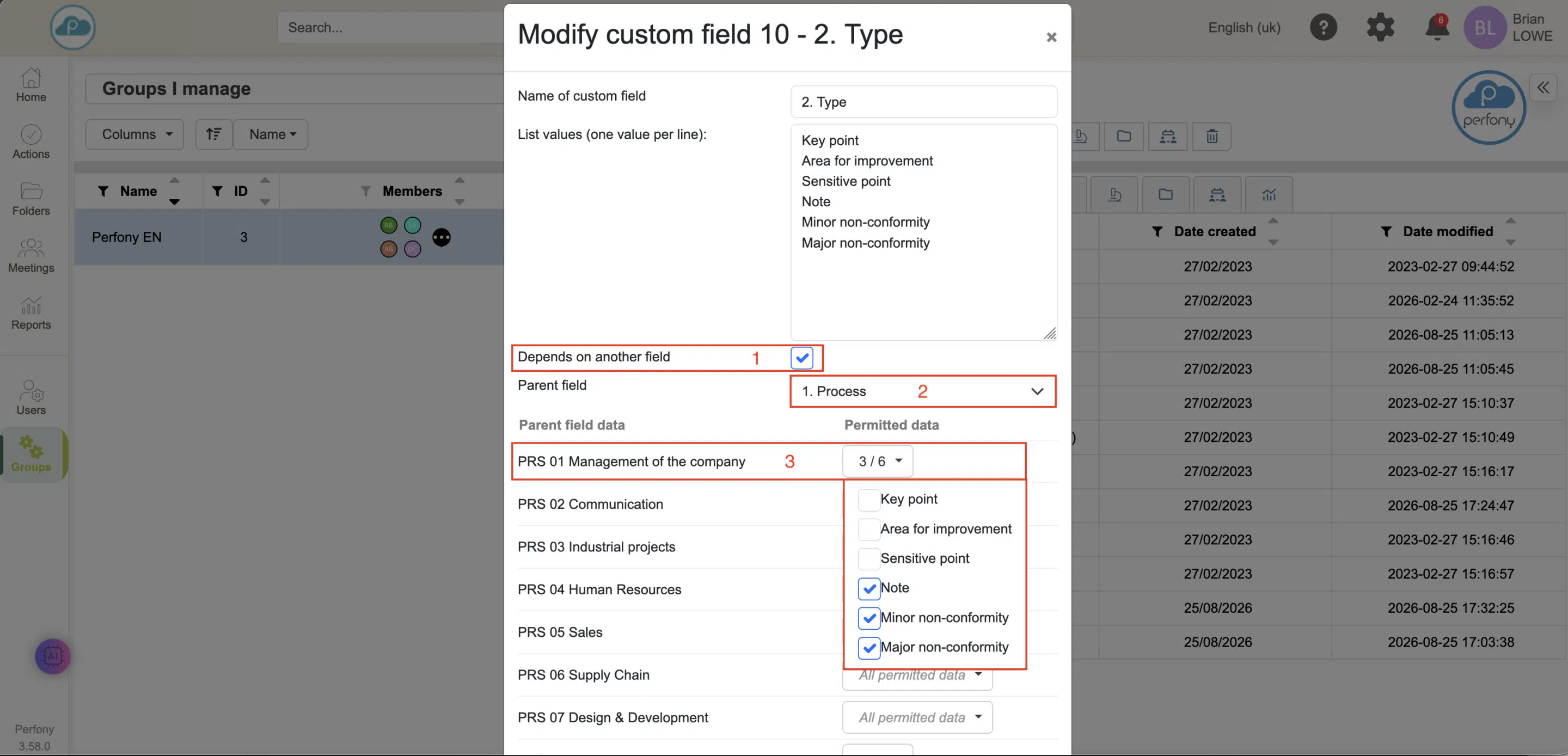
Configuring the relationship between two custom fields
From the “Group” menu:
Create or select the custom field to be conditioned on another field
Warning! This system only works with custom fields of the “list” type that allow a single selection.
Click “Depends on another field” (1)
Next, select the field in question from the list of available fields (2)
Next, for each value, set the possible responses (3)
Don’t forget to submit when you’re done
And make sure the linked custom fields are in the same folder template! Otherwise, your link won’t work.