
The search bar
Its use has been simplified as much as possible to save you the most time.

It allows you to search exclusively for a file, an action, a meeting or a decision by name.
When you enter the first 3 characters, a list of choices is displayed below the input field.
The results are presented classified by category (files, actions, meetings, decisions) and are identified at the beginning of the line by their respective icons.
Closed actions and archived folders appear grayed out but are still displayed and accessible.
Simply click on the desired item to access it directly.
If no result matches your entry, the list of choices does not appear below the input field, and a red sign with an exclamation mark indicates no possible result.
Searching for a folder
Type a few characters of the folder name: folders are recognised by the icon at the start of the line. Click the one you are looking for to open it. To find an archived or deleted folder, set the search options (below). The filters and sorting of the folder list are other ways to find it.
Choosing what the search looks for
The Search… box at the top of the screen finds actions, folders, meetings, comments, descriptions, documents, minutes and decisions. Its options are grouped by entity, in three columns: Actions, Folders and Meetings. Each column gathers the statuses to search and what the entity contains. You can thus find an archived or deleted folder, a closed action or a completed meeting, without being distracted by the rest.
Before you start
- The general search is available to every user, on a computer.
- The first time, everything is ticked: the search covers everything.
Setting the options
- Click the arrow on the right of the search box. The panel opens in three columns.
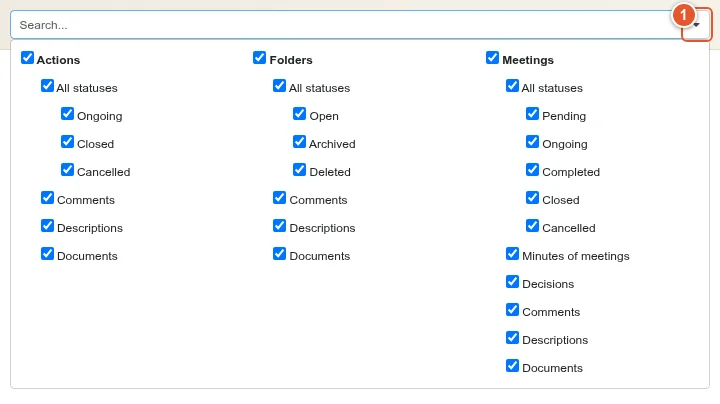
- In each column, tick or untick the statuses (All statuses ticks or unticks the whole list) and what you want to search: comments, descriptions, documents, and for meetings the minutes and the decisions. The checkbox at the top of a column (Actions, Folders, Meetings) turns the whole entity on or off.
- Close the panel (arrow or click elsewhere): your choices are applied.
- Type your search. The results follow your options; an archived folder is marked “[ closed ]”, a folder in the trash “[ deleted ]”.

Good to know
- Your choices are stored in your browser: they stay after a page reload and until you change them.
- Meeting statuses apply to the meetings themselves and to their minutes: with Closed only, you find the meetings that have a closed occurrence.
- A document is only proposed if its name contains the searched text.
- The mobile app searches among folders of all statuses and ongoing actions.
Video hosted on YouTube, shown once you accept cookies.