
Action Plan Definition: What Is It Used For?
An action plan is an operational document that lists the actions needed to reach an objective, and specifies for each one who is responsible, the deadline, the resources involved and how success will be measured. It is used to turn decisions into concrete results: it clarifies who does what and by when, lets the team follow progress, and shows early which actions are late or blocked.
What is an action plan?
An action plan is the link between a decision and its concrete implementation. It turns an objective, sometimes a vague one, into a series of actions that are assigned, dated and measurable. It helps a company make informed decisions by setting its priorities, use its human and financial resources as well as possible, and deal with problems and their solutions in an organized way.
It comes in many forms: management committee action plan, continuous improvement plan, quality action plan, project plan, transformation plan, or the plan that frames a digital transformation strategy. The form varies, but the logic is always the same: who does what, by when, with what resources.
An action plan is not a to-do list. A task is personal and informal. An action in a plan is collective, traceable and serves a shared objective.
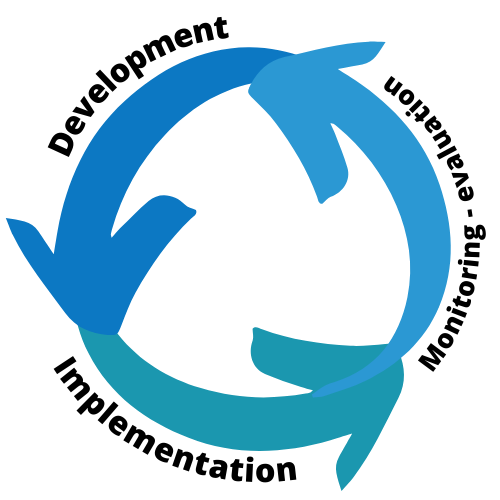
The process has three phases that follow one another in a loop: development, implementation, then monitoring and evaluation of results, which feeds the next version of the plan.
What does an action plan contain?
Every effective action plan rests on three minimum elements: a clear action, a named owner and a deadline. Other information makes steering easier:
| Element | What to write |
|---|---|
| Action | An action verb and a measurable deliverable: "Send the report to the client", not "report". |
| Owner | One named person, not a group or "the team". |
| Deadline | A precise date, agreed with the owner. A date imposed without discussion is rarely met. |
| Status | To do, in progress, done, blocked. Updated by the owner. |
| Priority | To sort actions when resources are limited and everything cannot move forward at once. |
| Resources | Human, material and financial means, and the overall budget if there is one. |
| Contributors | People involved without being responsible, informed of progress and called on if needed. |
| Success indicator | How you will know that the action has produced its effect. |
Depending on the context, the plan also specifies from the outset who oversees its implementation, who takes part (employees, partners, suppliers), the authorizations required, the foreseeable risks and the specific conditions for carrying out the project. To describe each action without forgetting anything, the 5W1H method provides a simple grid: What, Who, Where, When, Why and How.
What is an action plan used for?
An action plan adds value at several levels of an organization:
- Turning decisions into action. Without an action plan, a decision taken in a meeting remains an intention.
- Clarifying responsibilities. Everyone knows what they have to do, by when, and what the others are doing. Ambiguity is the first cause of inaction.
- Not forgetting anything. The plan lists the actions to be done and anticipates those to come.
- Following progress collectively. Management can monitor activities at any time and spot weaknesses while there is still time to correct them.
- Avoiding constant reframing. When the plan is clear, tasks are not redefined at every meeting, which slows everything down.
- Motivating teams. Seeing actions completed creates a sense of collective progress, and involving people in their own actions makes them accountable.
- Supporting a request. When you apply for funding, look for partners or defend a project, the action plan is usually the first document you are asked for.
When to use an action plan
Steering meetings and management committees
The action plan structures what happens after the meeting: each decision generates an action with an owner and a deadline, and the next meeting starts with a review of the previous actions. See our example of an action plan to follow up steering committee meetings.
Quality and continuous improvement
In a PDCA cycle (Plan, Do, Check, Act), the action plan is the central tool of the Plan and Act phases. It turns non-conformities and improvement areas into concrete, assigned actions.
Transformation projects
A digital transformation, a software rollout or a reorganization all need an action plan to coordinate teams and keep the course over time.
Day-to-day management
Beyond major projects, the action plan is the operational manager's tool for organizing the team's priorities week after week.
How to develop an action plan
- Set the objective. One clear, measurable objective per plan.
- Analyze the situation. Understand the causes before choosing the actions.
- List the actions needed to reach the objective, with the teams concerned.
- Assign an owner and a deadline to each action, and plan the resources.
- Set the schedule and the follow-up rhythm: weekly, every two weeks, at each meeting.
- Define the indicators that will show whether the objective is being reached.
The plan can take the form of a table, a Gantt chart or a simple text document. What matters is that it is shared and kept up to date. Our best practices for writing an action plan detail each step.
Communication and monitoring of your plan
All the employees concerned should know the phases of the action plan, its objectives and the role they will play in it. Involve your teams from the start: present the schedule to them and be open to their suggestions.
Later on, you will need to adapt the plan to new information and issues that arise along the way. Organize regular review meetings to get feedback from the people in charge of the actions and to share your decisions. When several people contribute to the same action, the RACI matrix helps to distinguish who carries it out, who is accountable, who is consulted and who is informed.
How to ensure the success of an action plan
- Involve the people concerned in building the plan, not only in carrying it out.
- Keep the document clear, simple to understand and easy to use.
- Set realistic deadlines, taking into account the constraints that could cause delays.
- Do not over-polish the plan. Spending too much time on the document delays its implementation. It is a steering tool, adjusted from one phase to the next, not a finished procedure.
- Update it outside meetings. Each owner updates their action as soon as it moves, and a blocked action is visible immediately.
Excel or a dedicated tool?
Excel remains the default tool for building an action plan. It is universal, known to everyone, flexible and customizable, and it calculates and presents data quickly. Its limits appear as soon as several people are involved.
| Excel action plan | Dedicated action management tool | |
|---|---|---|
| Creation | Quick, everyone knows how to use it | Quick, with ready-made templates |
| Updates | Out of date as soon as it is sent by email | Updated in real time by each owner |
| Reminders | Manual | Automatic, to each owner |
| Several plans | Consolidated by hand | Consolidated view across teams and projects |
| Meetings | Separate from the minutes | Actions created from the meeting minutes |
| History | Hard to trace who changed what | Full traceability of changes |
The choice depends on the size of the team, the number of plans to follow and how often they need to be updated. To compare in more detail, see our page on the action management tool.
The usefulness of an action plan is no longer in question. It turns intentions into realistic objectives, makes the most of a company's human and financial resources and produces concrete, measurable results, phase by phase and for the project as a whole.
In practiceAction plan softwareEvery decision becomes an action with an owner, a due date and a progress status. Reminders go out automatically. Native RACI, multi-entity consolidation, hosted in France. Free 15-day trial.Discover the softwareFrequently asked questions
What is the difference between an action plan and a project plan?
A project plan organizes the whole project (scope, phases, budget, milestones). An action plan lists the concrete actions to reach an objective, with an owner and a deadline for each, and can be one part of a project plan.
What are the three phases of an action plan?
Development, implementation, then monitoring and evaluation of results. The evaluation feeds the next version of the plan.
How often should an action plan be reviewed?
At each follow-up meeting, often weekly or every two weeks. Between reviews, each owner updates the status of their actions.
Who is responsible for an action plan?
One person oversees the plan as a whole, usually the manager or project lead, and each action has its own named owner.